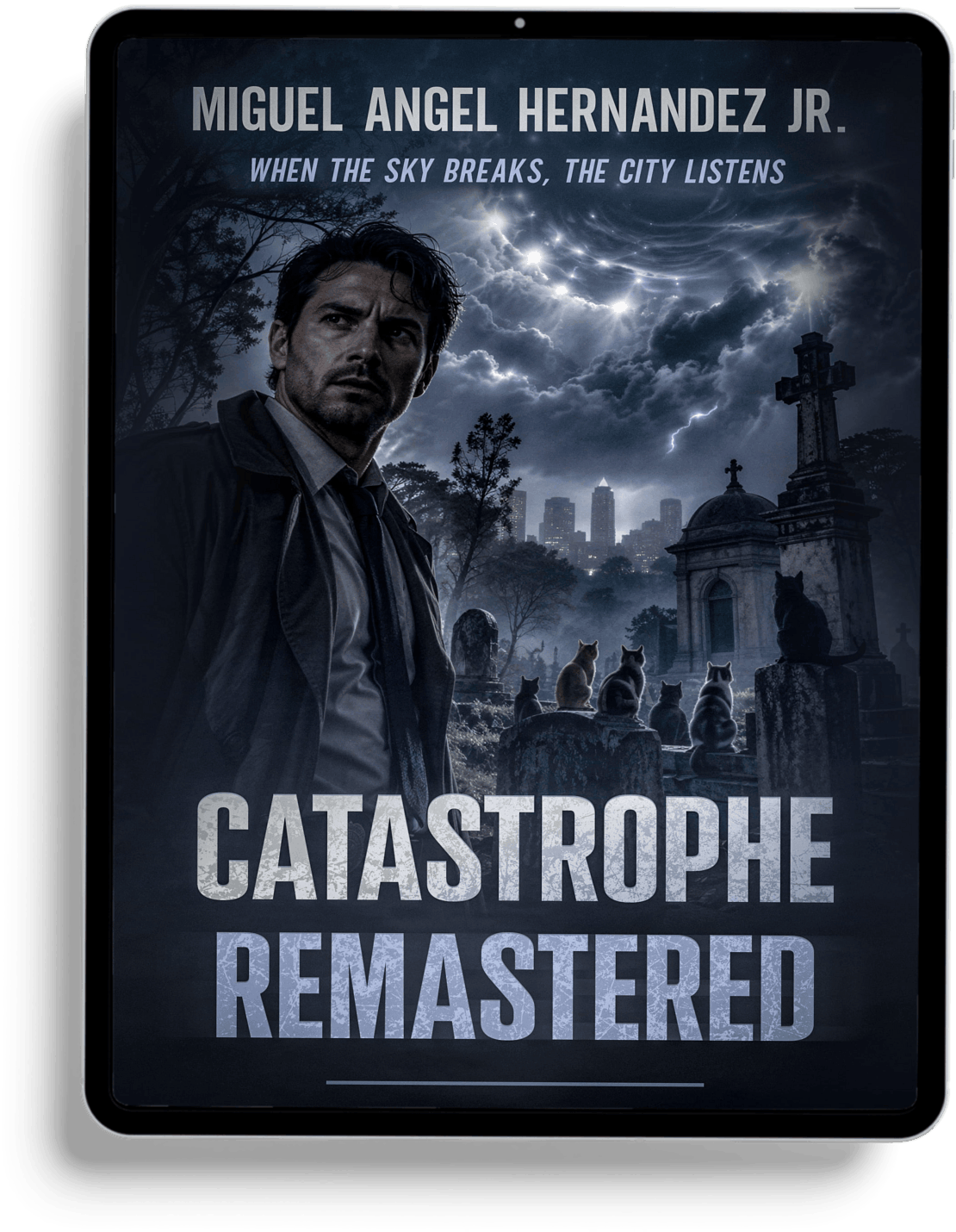
CATASTROPHE REMASTERED (EBOOK)
CATASTROPHE REMASTERED (EBOOK)
Couldn't load pickup availability
Book Description:
When the sky breaks, the city listens.
Atlanta is already terrified of the masked predator stalking its streets—but when an impossible craft tears open the night sky, the Reaper’s private ritual collides with something far more catastrophic.
CATASTROPHE REMASTERED blends serial‑killer horror, detective mystery, and cosmic suspense into a relentless, cinematic thriller. Jack Harris—the Reaper—chooses his victims with ritualistic precision, savoring the chase and the fear. But on the night he claims his fifth victim, the sky fractures above him, revealing a massive circular craft “moving with impossible steadiness” and flickering with patterns no human language can explain. The intrusion shatters his rhythm, alters his kill, and sets off a chain of events no one in Atlanta is prepared to face.
Detective Lucas Knight and his partner, Luna Blackwood, are already racing to stop the Reaper. Their investigation spirals when the latest crime scene reveals metallic residue, synchronized cats, seismic shockwaves, and forensic anomalies that defy every known explanation. As the city reels from the first catastrophe, Knight must confront a truth no detective is trained to face: the murders are no longer the worst thing happening in Atlanta.
For readers who crave dark thrillers, cosmic horror, procedural mysteries, and psychological suspense, CATASTROPHE REMASTERED delivers a gripping, atmospheric descent into fear—human and otherwise.
If you love serial‑killer tension, detective grit, and supernatural dread woven into one escalating nightmare, this is your next read. Grab your copy now and step into the catastrophe.
Readers Who Enjoy These Stories May Also Like
If you enjoy the high-stakes suspense of David Baldacci, the psychological tension of Freida McFadden, and the conspiracy-driven intrigue of modern thriller fiction, CATASTROPHE REMASTERED delivers a fast-moving mystery packed with danger, deception, and unexpected revelations.
Blending psychological suspense, corporate intrigue, and investigative thriller elements, the novel follows a trail of secrets that grow darker with every discovery. What begins as a mystery quickly becomes a fight for survival as hidden agendas, dangerous adversaries, and shocking truths collide.
Perfect for readers who enjoy:
- Conspiracy thrillers
- Psychological suspense
- Mystery thrillers with multiple revelations
- Secret organizations and hidden agendas
- Corporate and political intrigue
- High-stakes investigations
- Fast-paced, twist-driven storytelling
Comparable films and series include:
- The Fugitive
- Enemy of the State
- The Bourne Identity
- The Firm
- Jack Ryan
- Reacher
Comparable authors include:
- David Baldacci
- Freida McFadden
- Harlan Coben
- Brad Thor
- Gregg Hurwitz
Target Audience
CATASTROPHE REMASTERED is written for adult readers who enjoy intelligent thrillers that combine mystery, suspense, and uncovering dangerous secrets. Fans of page-turning investigations, hidden conspiracies, and psychological cat-and-mouse games will find plenty to keep them turning pages late into the night.
What Readers Are Saying:
Goodreads, Tina Fulcher ⭐⭐⭐⭐⭐
"Wow! What a story."
Goodreads, John Bitsko ⭐⭐⭐⭐⭐
"I would definitely recommend this book."
Goodreads, Mike ⭐⭐⭐⭐⭐
"...the writing and character development won me over."
Free Sample - Chapter 1:
THE FIFTH VICTIM
⟁
JACK HARRIS
My studio needed cleaning. My clothes covered the floor. Two empty Coke cans and a copy of Night Shift sat on the kitchen table. A gold chandelier had replaced the fluorescent fixture that hurt my eyes. My favorite horror novels filled a small bookcase against the wall.
The apartment smelled right: litter-box ammonia beneath old takeout and crusted noodles. Most people would have hated it. I didn’t.
The mess was honest. Like my mind, it was crowded and disorganized. Cleaning would have meant pretending otherwise.
Four hundred square feet made everything feel close. I liked that density.
Salt, my black Bombay, and Pepper, a copper-colored Oriental Shorthair, added to the disorder. They knocked things over, clawed furniture, and sometimes avoided the litter box I neglected.
But when I turned toward the kitchen, the cats had gone quiet. Both sat on the bed, staring at the far corner—the one with a water stain on the baseboard and books I meant to shelve. They weren’t watching the litter box, the window, or each other. They stared at the empty corner in perfect, unwavering synchrony.
“What is it, guys?”
Neither of them responded.
I studied the corner. Nothing. I looked back at them. Still nothing. Rats lived in old walls, and cats had their reasons. That was part of why I loved them.
I had always preferred cats to dogs. Cats were independent, low-maintenance, and quiet. Dogs barked too much.
“I’ll clean when I get back,” I told them. Beyond the window, a few pedestrians crossed beneath the Atlanta night sky. “Looks like rain again. Think I should still go out?”
Salt meowed, and I took it as approval. Pepper rarely spoke, but his almond-shaped green eyes seemed to agree. At the SPCA, they had approached me together. They were inseparable, so I brought them both home.
“Okay, then.” I nodded to myself.
I studied myself in the mirror. I was tall but still too thin, despite years of promising to work out. I ruffled my dark curls and smoothed my hoodie and cargo pants.
I lingered. My face needed attention—not creams or sleep, but practice. My behavior still required refinement.
I wondered whether tonight was the right night.
Part of me mistook waiting for discipline. Four days after the fourth victim had seemed prudent, but pressure accumulated, and pressure made the process sloppy.
Tonight, the conditions were right.
I had rules. I never wrote them down; observation had refined them into a method. They were not arbitrary. Each served a purpose.
First came age: late twenties. Old enough to have built a routine, a life, and a settled sense of herself. Younger women were still becoming.
Next came intention. She had to be there by choice. A woman stranded by a missed bus or failed ride was there by circumstance.
No. She had to choose the hour, the route, the errand—to enter the dark because the schedule was hers and she intended to keep it.
The last condition was harder to define but unmistakable when I saw it: beauty earned through transgression rather than preserved by perfection.
She had to possess all three. If one was missing, I moved on.
There were plenty of women around.
I adjusted my jaw and practiced smiling. The first attempt pulled too far to the right. I tried again. The third looked natural enough, so I held it and studied the result.
My mother’s voice surprised me, as it sometimes did.
“You’re perfect, Jack.”
There had been no doubt in my mother’s voice, only the quiet certainty she gave her most important advice. She believed perfection made people want to hurt her. She believed the same was true of me.
I slung my backpack over one shoulder, gave the mirror my best smile, and nodded. “You’re ready, Jack.” At the door, I waved to the cats. “Bye, guys. I’ll bring you something.”
In the hallway, I met Mrs. Nancy, an elderly tenant with short gray hair and a cane. She and her husband, Walter, had helped manage the building for decades. She remembered birthdays, accepted packages, and sometimes left pound cake outside my door.
Her face softened when she saw me. “Hello, Jack. I was beginning to wonder whether you’d gone quiet in there again.”
“Hello, Mrs. Nancy.” I raised a hand and smiled. “I’m heading out. Do you and Walter need anything?”
“We’re fine.” She studied my door. “Are you entertaining someone, or are Salt and Pepper making all that noise?”
I scratched my head and let the smile widen.
She misread my silence. “You need a friend who isn’t covered in fur. Someone who notices when you disappear.” Her concern showed beneath the teasing.
“You worry too much.” I backed away. “Tell Walter I said good night.”
I hurried past her and took the stairs instead of the elevator. Six floors made for a decent workout.
Outside, I drew a deep breath.
The air felt heavy. Wind scattered leaves beneath flickering streetlights while traffic hissed over the pavement.
After savoring the atmosphere—and attracting several strange looks—I continued toward the cemetery.
Oakland Cemetery held the quiet of old places.
Tonight, wind surged through the magnolias, twisting their shadows across the outer wall.
The old cemetery held landmarks I had learned that week: a one-winged weeping angel, a moss-covered obelisk, and a stone bench beside a long-neglected grave.
At night, the statues seemed to move—or their shadows did, stretching and contracting in the wind, convincing enough in the corner of an inattentive eye.
Well, I was.
Thunder rolled in the north. Pressure settled in my chest. I had felt it twice before, on nights worth remembering.
Lightning flashed again, and something glistened in the sky for a second. It vanished before I could understand what I had seen.
That didn’t matter. The night shifted into a weapon I could use.
I hid behind an ancient, weathered mausoleum, set down my backpack, and stretched as damp earth and decaying leaves filled my nose.
I peered around the mausoleum. A beautiful woman in her late twenties moved between the graves, wearing a cream overcoat and red scarf.
She had visited her grandfather’s grave after working all day. Night was her only free time. I knew because I had watched her for several days.
Before leaving, she knelt to straighten the small bundle of white flowers at the grave. One stem had snapped in the wind. She tucked it beneath the others, brushed dirt from the engraved name with her thumb, and whispered, “I got the promotion. I wish you were here.”
Then, her phone lit with a message. She smiled before typing back: Home soon. Save me cake. She slipped the phone into her coat and started toward the gate.
The first night I watched from the east gate. Each night, I moved closer until I could hear her heels on the gravel.
I knew the rhythm: the pause at an uneven stone, the slower steps near the grave, the quickened pace as she left.
A subtle floral scent traveled with her on the wind. She was not someone who demanded attention.
I thought of the four before Maria. Christie Stanton, a nurse, checked every dark window after long shifts. Rebecca Van Houten called her mother while walking home. Kazuko Matsuda noticed me from a block away and nearly escaped. Reina Sastre, once a security guard, kept searching for exits until the end.
Maria had what the others lacked. For four nights, I watched her leave flowers at her grandfather’s grave after work. Grief had an appointment, and she never missed it.
That discipline chose her for me.
She met all the conditions.
I crouched behind the corner, humming as I searched my bag for my Benchmade 940 Osborne and white ceramic mask. I slipped on the mask, hid the knife behind my back, and stepped into view.
I followed her until my footsteps drew too close to be ignored. She glanced back, saw the mask, and faced forward again, still pretending Halloween explained me.
At the next turn, I was still behind her. Suspicion tightened her shoulders. Excitement accelerated my pulse.
She quickened her pace. I matched it.
This was the part I liked second best: the instant unease became certainty. Her body understood before she ran.
She broke into a run and stumbled on an uneven flagstone. Her keys fell into the grass. She spared them one glance and kept moving.
Christie would have stopped for the keys. Kazuko would have thrown them at me. Maria understood what the next thirty seconds were worth.
A heel caught in the soft ground. She abandoned that too. Good instinct. Clear thinking amid panic.
She aimed for the locked east gate. I cut between the graves, using the route I had mapped during four nights of watching her.
Lightning exposed me as I stepped from the tree line ahead of her. Horror transformed her face, and she changed direction at once.
Then I ran. She was quick enough to make me work, and I was glad of it. Cold air flooded my lungs as I chased her through the dark.
Ten feet separated us, then five, then three.
I burst from the bushes beyond the oak grove, seized her, and took us both to the ground.
She opened her mouth to scream. I covered it and laid the knife against her throat.
The blade caught the lightning. Her body went rigid.
This was why I did it—not for the numb silence afterward, but for the instant everything narrowed to our bodies, the knife, and the surrounding dark.
Nothing matched the chase, their fear, or the knowledge that I would be the last thing they saw.
I felt no guilt. I understood its purpose; I simply could not find it in myself. My mother would have called that perfection.
Her breath came hot and fast against my palm. Beneath her perfume lay damp earth and cold mulch.
“Shh.” I leaned close to her ear. “Don’t make a sound.”
I waited for the bargain to form in her mind—the belief that obedience might purchase survival. It was always a lie.
In that moment, I alone decided when she died.
When I lifted my hand, she begged me not to kill her.
“All I want is you,” I replied. It was the truth.
“I don’t know you. I did nothing to you.”
“No.” I stroked her cheek. “You did nothing. You’re perfect.”
“I don’t understand,” she said. “I don’t—”
I covered her mouth and drove the knife into her abdomen. “You don’t have to understand.”
I pulled the knife free and struck twice more. Laughter escaped me.
Then a sound unrelated to the storm—something like a small aircraft—drew my gaze upward.
Above me, the clouds flickered white.
A perfect circle crossed the sky. It was no weather balloon or conventional aircraft. It moved with impossible steadiness, leaving no exhaust and making no engine noise proportionate to its immense size.
White lights patterned its underside without repeating. They did not blink like navigation beacons; they flickered with deliberate irregularity, like a language delivered without translation.
“What in the world is—”
I had no rational explanation. That was the honest conclusion.
A shallow, wet breath beneath me reminded me that Maria still lived. Her eyes had left me for the sky. One hand moved weakly toward the phone in her coat, toward the family waiting with cake.
For several seconds, the dying woman and I watched the same impossible thing.
I had intended to reduce her to a moment in my private ritual. Instead, the sky gave her somewhere beyond me to place her final attention. I resented it.
Then the sky came apart—the first catastrophe, though none of us understood yet how many others it contained.
The boom struck without warning. The ground threw me from Maria. Branches crashed across the path.
A stone urn toppled from its pedestal, its impact echoing between the mausoleums. Behind me, the east gate rattled in its frame.
When the echoes faded, I rolled onto my back. The aircraft was gone.
A laugh escaped me—not amusement, but the body’s answer to something too large to understand.
The night had ceased to belong to me.
Then, I heard footsteps.
Fast footsteps approached along the south path. I froze above Maria’s body.
A figure moved between the graves in a steady rhythm.
A jogger in his thirties approached in a gray hoodie and earbuds. His path would bring him within fifteen feet of the mausoleum. One turn of his head would expose me.
My grip tightened on the knife. If he saw me, I would have to kill him. The thought irritated me; he did not fit my rules and chasing him would be inconvenient.
I held my breath. My pulse was hammering, and I watched him approach.
He never looked over. Locked into his pace and breathing, he passed without a glance and faded north.
I remained still for ten seconds after the footsteps vanished.
Then I exhaled.
I returned to Maria. Death had fixed the fear in her open eyes. Her head rested to one side as blood crept toward her shoulders.
I stroked her cheek with the back of my hand.
Beautiful.
▲